
Last Updated on August 20, 2026 by Abdul Rehman
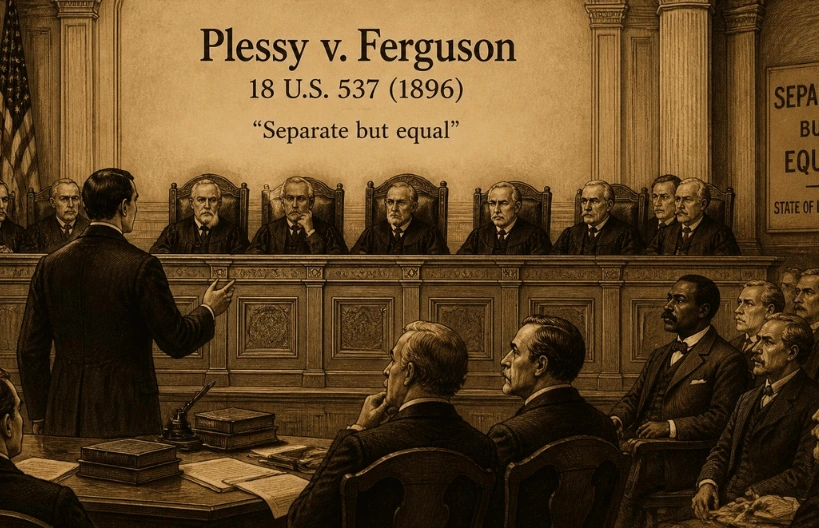
Plessy v. Ferguson was an 1896 U.S. Supreme Court decision that upheld Louisiana’s racial segregation law for railroad passengers. The Court ruled that legally required separation did not violate the Fourteenth Amendment if the accommodations were considered equal. The decision gave constitutional support to the “separate but equal” doctrine and helped strengthen Jim Crow segregation.
The case began as a planned challenge to Louisiana’s Separate Car Act rather than an accidental dispute over train seating. Homer Plessy agreed to test the law in 1892. His arrest gave rise to the constitutional challenge that eventually reached the U.S. Supreme Court.
Key Facts At a Glance
| Case detail | What to know |
| Full case | Plessy v. Ferguson, 163 U.S. 537 |
| Supreme Court decision | May 18, 1896 |
| Vote | 7–1 in favor of Ferguson |
| Law challenged | Louisiana Separate Car Act |
| Main constitutional issue | Fourteenth Amendment Equal Protection Clause |
| Other constitutional arguments | Thirteenth Amendment |
| Majority opinion | Justice Henry Billings Brown |
| Sole dissenter | Justice John Marshall Harlan |
| Main doctrine associated with the case | “Separate but equal” |
| Major later turning point | Brown v. Board of Education in 1954 |
Key Takeaways
- The dispute arose from a deliberate test of Louisiana’s segregation law.
- The Supreme Court accepted government-required racial separation under its interpretation of the Equal Protection Clause.
- The decision became closely associated with the “separate but equal” doctrine.
- Justice Harlan rejected the majority’s constitutional reasoning.
- The ruling gave legal support to racial segregation during the Jim Crow era.
- Brown v. Board of Education later rejected racial segregation in public schools as unconstitutional.
- Louisiana posthumously pardoned Homer Plessy in 2022.
What Happened Before the Supreme Court Case?
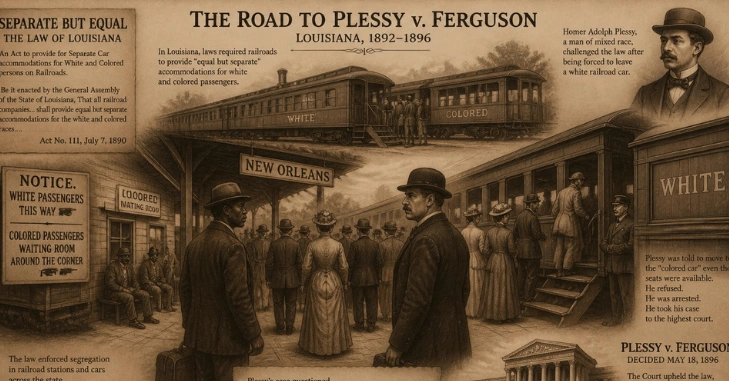
Louisiana enacted the Separate Car Act in 1890. The law required railroads carrying passengers within the state to provide separate accommodations for white and Black passengers. Violating the law could result in a fine or imprisonment.
A New Orleans group known as the Citizens’ Committee organized a legal challenge. Its members wanted to create a test case that could move through the courts. Homer Plessy volunteered to participate.
On June 7, 1892, Plessy bought a first-class ticket on a train traveling within Louisiana. He sat in a coach reserved for white passengers and refused to move when asked. Authorities then arrested him under the Separate Car Act.
Plessy challenged the prosecution before Judge John H. Ferguson. His lawyers argued that the segregation law violated the U.S. Constitution. Ferguson rejected the claim, and the dispute continued through the Louisiana court system before reaching the U.S. Supreme Court.
Readers interested in similar legal disputes can explore Magazinexu’s broader Law section for additional legal topics.
What Did Plessy v. Ferguson Decide?
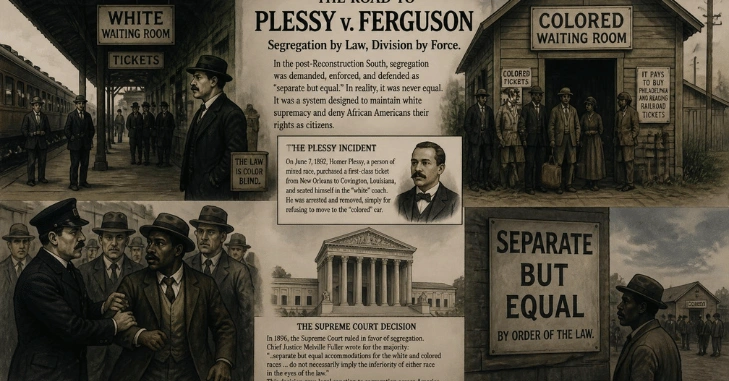
The Supreme Court ruled in favor of Ferguson on May 18, 1896, by a 7–1 vote. Justice Henry Billings Brown wrote the majority opinion, while Justice John Marshall Harlan was the only dissenter. The majority rejected the argument that Louisiana’s law violated the Thirteenth Amendment’s prohibition of slavery. It also rejected Plessy’s Equal Protection argument under the Fourteenth Amendment.
The Court reasoned that legally separating passengers by race did not automatically create unconstitutional inequality. Under this interpretation, states could require racial separation while maintaining that the separate facilities were legally equal. That principle became known as “separate but equal.” In practice, segregation laws separated people in transportation, education, and many other areas of public life. Facilities available to Black Americans were frequently unequal in quality, funding, and access.
The Majority Opinion and Harlan’s Dissent
The sharp disagreement between the majority and Justice Harlan helps explain why the case remains important in constitutional law.
| Issue | Supreme Court majority | Justice Harlan’s dissent |
| Racial separation | State law could require racial separation without automatically violating equal protection. | The government should not assign legal rights based on race. |
| Fourteenth Amendment | Did not prohibit this form of state-required separation | Should protect citizens from racial classifications imposed by law |
| View of Louisiana law | Constitutionally permissible | Inconsistent with equal citizenship |
| Long-term influence | Supported the legal basis for segregation | Became an influential constitutional argument against racial segregation |
Harlan argued that the Constitution should not permit the government to create racial classes among citizens. His dissent did not control the law in 1896, but its reasoning later became influential in constitutional debates about equality. This contrast is useful for students because it separates two important questions. The first is what the Court’s majority permitted at the time. The second is why a dissenting justice believed that interpretation conflicted with the principle of constitutional equality.
Why The Ruling Mattered During The Jim Crow Era
The decision did more than resolve a dispute involving one railroad car. It gave constitutional support to state-enforced racial separation at a time when Jim Crow laws were expanding across parts of the United States. Jim Crow laws legally separated Black and white Americans in many areas of public life. The 1896 ruling allowed state-sponsored segregation to continue under the claim that separate facilities could still provide equal treatment.
That legal framework remained influential for more than half a century. The formal promise of equality also concealed a major practical problem. Separate schools, transportation systems, and public facilities were often unequal in funding, quality, and access. For this reason, the case is frequently taught as an example of the difference between equality expressed in legal language and equality experienced in everyday life.
How Brown v. Board Changed the Doctrine

The Supreme Court reached a different conclusion about racial separation in public education in 1954. In Brown v. Board of Education, the Court unanimously held that state-imposed racial segregation in public schools violated the Equal Protection Clause. The Court concluded that separate educational facilities were inherently unequal.
The decision directly rejected the separate-but-equal doctrine as it applied to public education. That distinction matters. The 1954 decision did not eliminate every form of legally enforced segregation through a single school case. It did, however, undermine one of the central constitutional foundations used to defend government-mandated racial separation.
For this reason, saying that “Brown overturned everything in 1954” is too broad. A more accurate explanation is that Brown rejected separate-but-equal public schooling and became a major constitutional turning point in the fight against government-enforced segregation.
A Modern Epilogue: Homer Plessy’s 2022 Pardon
The legal story received an unusual modern ending more than a century after Plessy’s arrest. On January 5, 2022, Louisiana Governor John Bel Edwards granted Homer Plessy a posthumous pardon for his conviction under the Separate Car Act.
The pardon did not change the Supreme Court’s historical ruling. Instead, it addressed the state conviction that resulted from Plessy’s planned challenge to the segregation law in 1892. The pardon also illustrates how public and legal attitudes toward the case changed over time. A man once convicted for challenging a segregation law was formally pardoned by the same state more than 125 years later.
How to Remember the Case for Class or an Assignment?
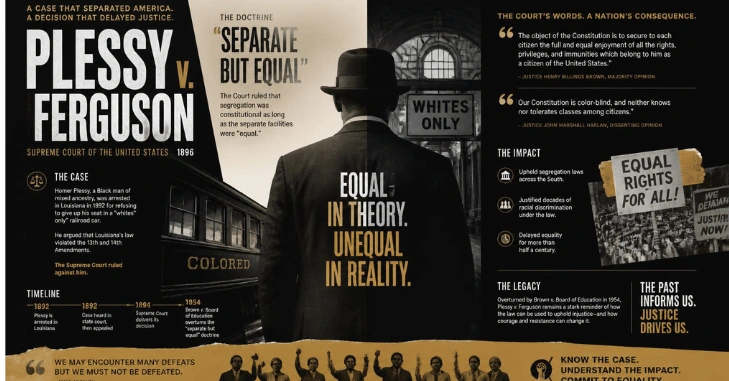
You can reduce the case to five main points without losing its constitutional significance:
- Facts: Louisiana required separate railroad accommodations based on race.
- Challenge: Homer Plessy deliberately tested the law and was arrested.
- Ruling: The Supreme Court upheld the segregation statute by a 7–1 vote.
- Doctrine: The decision became associated with “separate but equal.”
- Later change: Brown v. Board of Education rejected this doctrine in public schools.
When writing about the case, separate the facts, constitutional issue, holding, reasoning, and dissent. This structure makes legal analysis easier to understand and follow.
Magazinexu’s guide to earning stronger scores on law assignments also discusses approaches that can help students organize legal coursework. Students looking for broader academic material can browse Magazinexu’s Education section for additional study-focused content.
Conclusion
Plessy v. Ferguson remains one of the most significant and controversial decisions in U.S. constitutional history. In 1896, the Supreme Court upheld Louisiana’s law requiring racially separate railroad accommodations and gave constitutional support to the “separate but equal” doctrine. The decision helped provide legal justification for Jim Crow segregation for decades, despite the reality that segregated facilities were often deeply unequal.
Frequently Asked Questions
The Supreme Court upheld Louisiana’s racial segregation law for railroad passengers. The majority concluded that legally separate accommodations did not violate the Fourteenth Amendment simply because passengers were separated by race.
The doctrine allowed governments to separate people by race while claiming that each group received equal facilities or treatment. In practice, segregated facilities for Black Americans were frequently unequal.
The case involved arguments under both the Thirteenth and Fourteenth Amendments. The Fourteenth Amendment’s Equal Protection Clause became the central constitutional issue. The Supreme Court rejected both constitutional challenges.
Brown v. Board of Education rejected the doctrine in public education in 1954. The Supreme Court ruled that state-mandated racial segregation in public schools violated the Equal Protection Clause.
The decision shows how constitutional interpretation can either protect or restrict civil rights. It also provides students with a clear example of the relationship between a controlling majority opinion, a powerful dissent, and a later change in Supreme Court doctrine.