
Last Updated on October 6, 2026 by Nasir Hanif
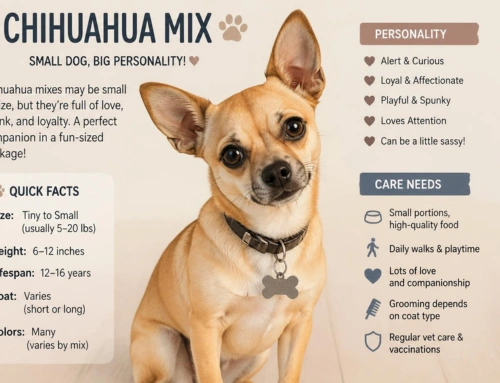
A Chihuahua mix combines the tiny, alert toy dog with another breed, so appearance and personality can vary much more than a purebred dog’s. Many stay small, affectionate, lively, and strongly attached to their people, but the second parent can change everything from coat and energy level to adult size. That variability makes the individual dog more important than the designer name attached to it.
| Quick fact | What owners should expect |
| Breed status | A mixed-breed dog without one universal breed standard |
| Adult size | Often small, but the other parent strongly affects height and weight. |
| Temperament | Commonly alert and people-focused, with wide individual variation |
| Lifespan | Many small crosses live well into their teens. |
| Exercise | Daily walks, play, and mental activity suited to the individual |
| Grooming | Depends heavily on coat type |
| Training | Early socialization and reward-based training are valuable. |
| Health focus | Teeth, knees, airway, weight, and inherited risks from both parents |
Quick answer: These dogs can make affectionate, entertaining companions for owners who understand that crossbreeding does not produce a fixed set of traits. Size, coat, behavior, and health depend on both parents. Meeting the individual dog and learning its history usually tells you more than the mix name alone.
Key Takeaways
- Crosses do not have a guaranteed size, coat, or personality.
- Small individuals need protection from rough handling and unsafe interactions with larger animals.
- Dental care and routine veterinary checks deserve particular attention.
- Early socialization can help manage barking, fear, and overprotective behavior.
- Adult rescue dogs offer more predictable size and temperament than young puppies.
What Is a Chihuahua Mix?

A Chihuahua mix has Chihuahua ancestry plus one or more other breeds in its background. Names such as Chiweenie, Chug, Pomchi, and Chorkie describe particular parent combinations, but they do not create a standardized breed. PetMD notes this lack of a breed standard for crosses such as the Chug and Chipoo, which is why even puppies from similar pairings may look and behave differently.
The purebred parent gives owners a useful reference point rather than a guaranteed blueprint. The AKC standard limits a purebred Chi to no more than six pounds and describes the breed as alert, compact, and confident, yet adding another parent broadens the possible outcome. Genetics, early experiences, socialization, training, health, and home environment all help shape the adult dog.
Size, Appearance, and Coat Can Vary Widely
Many of these crosses remain compact because one parent is among the smallest recognized dog breeds. A pairing with a Pomeranian, Yorkshire Terrier, or Toy Poodle may still produce a tiny adult, while a Beagle or larger terrier parent can increase the potential size. For a puppy, the parents’ adult sizes offer a better clue than the fashionable name used to describe the cross.
Coats can be smooth, wiry, fluffy, long, or somewhere between those types. Ears may stand upright or fold, while muzzle length and body proportions can favor either side of the family. Shedding also depends on inherited coat traits, so a Poodle cross should never be assumed to have a particular coat or to be suitable for every allergy-sensitive household.
Temperament and Family Fit
The purebred parent is known for being alert, confident, intelligent, and strongly connected to its people. The AKC also notes that early training and socialization matter, while the breed’s small size can make rough play with young children risky. A mixed dog may inherit those tendencies, traits from the second parent, or a combination that is difficult to predict beforehand.
A good match depends less on the label and more on the dog’s behavior around the people and animals in your home. Very small dogs may need supervised interactions with children and larger pets because an accidental fall or collision can cause injury. Prospective owners should also consider barking, confidence around strangers, handling tolerance, and how the dog responds when left alone.
This type of dog may suit you if you:
- Want a compact companion that can fit many apartment or smaller-home lifestyles.
- Can provide daily attention, training, play, and short outdoor activities.
- Are willing to supervise a tiny dog around children and much larger animals.
- Prefer evaluating an individual dog’s temperament instead of expecting fixed breed traits.
12 Popular Chihuahua Mix Types
Lists of popular crosses commonly feature small companion breeds, terriers, and several slightly larger dogs. Adopt a Pet and other current breed resources include many of the following combinations, although the names are informal and traits still vary from dog to dog. Use the second-parent column as a clue about possibilities rather than a promise about the puppy you may bring home.
| Mix name | Other parent | Traits that may appear |
| Chiweenie | Dachshund | Compact build, alert nature, strong attachment |
| Chug | Pug | Sturdier body, playful personality, shorter muzzle |
| Pomchi | Pomeranian | Fluffier coat, alertness, lively behavior |
| Chorkie | Yorkshire Terrier | Silky coat, terrier energy, close bonding |
| Chipoo | Poodle | Wavy or curly coat, active and trainable nature |
| Cheagle | Beagle | More size, curiosity, scent-driven behavior |
| Jack Chi | Jack Russell Terrier | High energy, athleticism, terrier instincts |
| Chion | Papillon | Fine build, feathered coat, active personality |
| Shichi | Shih Tzu | Longer coat, companion-oriented behavior |
| Chipin | Miniature Pinscher | Sleek build, alertness, active temperament |
| Malchi | Maltese | Small frame, longer coat, companion traits |
| BoChi | Boston Terrier | Broader build, playful and social tendencies |
One useful rule applies across the entire table: the name predicts ancestry better than it predicts behavior. Two dogs carrying the same mix label can still have different coats, energy levels, confidence, and adult proportions. Meeting an adult dog gives you far more certainty because its physical size and much of its mature behavior are already visible.
Daily Care, Training, Exercise, and Grooming
Small size does not remove the need for exercise or training. These dogs benefit from daily walks, play, sniffing opportunities, and simple training games that engage their minds. Reward-based training is especially useful for teaching calm greetings, recall, handling skills, and alternatives to excessive barking.
A practical care routine should cover several areas:
- Exercise: Use walks and play sessions matched to your dog’s age, size, and stamina.
- Training: Reward wanted behaviors consistently rather than excusing poor manners because the dog is small.
- Socialization: Build positive experiences with people, sounds, surfaces, handling, and suitable dogs.
- Grooming: Brush according to coat type and check the ears, nails, skin, and eyes regularly.
- Dental care: Build tooth care into the routine and discuss professional dental checks with your veterinarian.
Dental care deserves extra attention because small mouths can be prone to crowding and periodontal disease. PetMD lists dental disease among the health concerns seen in the purebred parent and explains that routine brushing and veterinary dental care can help protect oral health. Magazinexu’s broader guide to veterinary hospitals also explains why preventive care can identify problems before they become more difficult to manage.
Health and Lifespan of a Chihuahua Mix
A Chihuahua mix can inherit health risks from either side of its family, so crossbreeding should not be treated as a guarantee of better health. Concerns associated with the toy-breed parent include luxating patellas, periodontal disease, obesity, and collapsing trachea, while the other breed may introduce different inherited risks. A veterinarian who knows the dog’s ancestry, physical build, age, and history can provide a much more useful risk assessment.
| Area to watch | What owners may notice |
| Dental health | Bad breath, tartar, inflamed gums, difficulty eating |
| Knees and joints | Skipping steps, limping, occasionally holding up a rear leg |
| Airway | Persistent or unusual coughing, breathing changes |
| Weight | Gradual weight gain that puts added strain on a small frame |
| Behavior | Anxiety, fearfulness, or stress that interferes with normal routines |
Recent veterinary data adds useful context without defining every dog. A 2026 Dutch report based on two years of its own veterinary consultations found flea-and-tick concerns, allergies, and anxiety among the most frequent reasons owners of these mixed dogs contacted its vets. Those figures describe Dutch’s own patient population rather than national disease prevalence. Owners who want to understand diagnostic screening can also read Magazinexu’s guide explaining why blood work is used in animal hospitals.
Life expectancy cannot be reduced to one reliable number because the other parent, adult body size, genetics, and medical care all matter. Zoetis gives a general 14–19 year profile for this mix category, while the AKC notes that small dogs as a group often outlive larger dogs and lists purebred Chihuahuas among the longer-lived breeds. Those ranges are planning guides, not promises for an individual pet.
Choosing or Adopting the Right Dog in the US
Start with the individual rather than searching only for a fashionable designer name. Ask a shelter, rescue, or responsible breeder what is known about the parents, medical history, behavior, handling, and previous home environment. If you are meeting an adult rescue dog, spend enough time together to see how it reacts to touch, strangers, noise, walking, and other animals.
Use this four-part predictability check before making a decision:
- Body: Is the dog’s current or expected adult size safe for your household?
- Behavior: Do its energy level, sociability, and confidence fit your routine?
- Background: What is known about ancestry, veterinary history, and previous behavior?
- Backup plan: Do you have a veterinarian and a plan for urgent care if the dog becomes sick or injured?
For US owners, a veterinary appointment soon after adoption can establish a baseline and address vaccines, parasite prevention, teeth, weight, knees, and any breed-specific questions. Magazinexu’s Pets section provides more general pet-care reading, while its veterinary urgent-care guide can help owners understand when a problem may need prompt attention rather than a routine appointment. Keeping those resources handy can make decisions easier when your new companion’s health or behavior changes.
Conclusion
A Chihuahua mix can be a loving, lively, intelligent, and entertaining companion, but there is no single personality, appearance, or size that applies to every cross. The second parent can significantly influence everything from adult weight and coat type to exercise needs, energy level, trainability, and potential health concerns. For that reason, the mix name should be treated as a starting point rather than a guarantee of what a particular dog will be like.
Prospective owners should look beyond appearance and consider the individual dog’s temperament, background, size, activity level, socialization, and medical history. Small dogs still need consistent training, daily exercise, mental stimulation, dental care, grooming, and appropriate veterinary attention. Because their tiny bodies can be vulnerable to accidental injuries, careful supervision around young children and much larger pets is also important.
Frequently Asked Questions
Are these mixed dogs good family pets?
They can be excellent family companions when the individual dog’s personality fits the household. Tiny dogs need careful supervision around young children who may accidentally drop, step on, or play too roughly with them. Introductions to other pets should also be controlled, especially when there is a major size difference.
How big do they usually get?
There is no fixed adult weight because the second parent can range from another toy breed to a substantially larger dog. The parents’ sizes, the puppy’s development, and ancestry provide better clues than a designer label. An adult rescue dog removes much of this uncertainty because its full size is already apparent.
How long does a Chihuahua mix live?
Many small individuals can live well into their teens, although no single lifespan applies to every cross. Genetics, the second parent, body size, dental health, weight, preventive care, and disease all affect longevity. Regular veterinary care gives owners the best chance to identify health changes early. Elsewhere on the site: Toyger Cat Guide for U.S. Owners.
Are these dogs easy to train?
Many are bright and capable learners, but confidence and independence can make consistency important. Use rewards, brief training sessions, and early socialization rather than punishment or intimidation. Treating a small dog with the same behavioral expectations as a larger pet can prevent nuisance habits from becoming established.
Where can I find one to adopt?
Local animal shelters, foster-based rescue groups, and national adoption databases are useful places to start in the United States. Adopt a Pet currently maintains information and adoption searches for several of these popular crosses, including Chiweenies and Pomchis. Meet the dog personally whenever possible and ask for all available medical and behavioral records before committing.